A Complete Guide to Patios, Pergolas & Exterior Spaces
Outdoor living is one of the biggest advantages of living in Southern California. Patios, pergolas, balconies, outdoor kitchens, and covered seating areas often function as an extension of the home.
But Los Angeles sunshine can also make those spaces difficult to use during certain parts of the day.
Strong afternoon sun can create glare, raise temperatures, fade outdoor furnishings, and make an otherwise beautiful patio uncomfortable.
That is where outdoor shades can make a meaningful difference.
Also known as exterior shades, patio shades, outdoor roller shades, or exterior solar shades, these systems are designed to control sunlight before it reaches the areas where you live and relax.
In this guide, we’ll explain how outdoor shades work, where they can be used, how fabrics and openness levels affect performance, when motorization makes sense, and what Los Angeles homeowners should consider before choosing a system.
What Are Outdoor Shades?
Outdoor shades are retractable shading systems designed specifically for exterior applications.
Unlike standard indoor shades, exterior systems use fabrics, hardware, mounting components, and guidance systems selected for outdoor conditions.
They can be installed around spaces such as:
- Covered patios
- Pergolas
- Outdoor kitchens
- Poolside seating areas
- Balconies
- Large exterior openings
- Suitable windows and sliding glass doors
Most outdoor shades lower vertically and retract when they are not needed.
This allows you to add sun protection without permanently enclosing the space.
For homeowners who already use roller shades indoors, the concept may look familiar, but outdoor applications require different materials and installation considerations.
Why Outdoor Shades Work So Well in Los Angeles
Los Angeles has an unusually strong indoor-outdoor lifestyle.
Large sliding doors, covered patios, modern pergolas, and backyard entertaining spaces are common throughout the San Fernando Valley and West Los Angeles.
The problem is that the sun does not always cooperate with the architecture.
A west-facing patio, for example, may feel comfortable in the morning but become difficult to use later in the afternoon.
Exterior shading can help address that problem at the source.
1. Reduce direct sunlight
Outdoor shades intercept sunlight before it enters the patio or reaches exterior-facing glass.
That can make seating and dining areas substantially more usable during bright periods of the day.
2. Reduce glare
Solar-screen fabrics help soften harsh glare while still allowing varying degrees of outward visibility.
This is especially useful around:
- Outdoor televisions
- Dining areas
- Lounge spaces
- Poolside seating
- Home offices adjacent to patios
3. Make outdoor areas more comfortable
Reducing direct solar exposure can make a covered patio or pergola more comfortable without turning it into an enclosed room.
4. Add privacy
Outdoor shades can also provide additional privacy from neighboring properties, streets, or nearby buildings.
How much privacy you get depends largely on the fabric and its openness.
5. Protect furnishings and finishes
Reducing prolonged direct sunlight may also help limit UV exposure on outdoor furniture, flooring, finishes, and nearby interior furnishings.
Outdoor Shades vs. Indoor Shades: What’s the Difference?
Both products control sunlight, but they do it at different stages.
An interior shade controls light after sunlight has reached the window.
An exterior shade can stop or filter sunlight before it reaches the patio or exterior glass.
That difference becomes important when the main problem is heat or intense direct sun.
For interior spaces, products such as light-filtering shades can provide excellent glare control and privacy while maintaining natural light.
For patios and exterior areas, however, an outdoor-rated system is generally the more appropriate solution.
Another important difference is construction.
Outdoor shade systems may include:
- Exterior-rated screen fabrics
- Heavier-duty roller tubes
- Side channels or tracks
- Cable guidance systems
- Enclosed headboxes or cassettes
- Exterior-rated motors
The correct combination depends on the specific opening and exposure.
Where Can Outdoor Shades Be Installed?
One reason outdoor shades have become popular is their flexibility.
They can work across many architectural settings.
Patio Shades
Covered patios are one of the most common applications.
A vertical patio shade can be lowered when low-angle sunlight enters from the side and raised again once the sun moves.
This gives you protection only when you need it.
Pergola Shades
Pergolas often provide overhead shade while leaving their sides completely open.
That works well when the sun is high in the sky, but morning or afternoon sun can still enter horizontally.
Adding outdoor shades to one or more sides of a pergola can help control that low-angle sunlight without eliminating the open-air feeling.
Outdoor Kitchens and Dining Areas
Direct sunlight can make outdoor cooking and dining uncomfortable.
Exterior shades can help create a more controlled environment around outdoor kitchens, bars, and dining tables while remaining retractable when conditions are comfortable.
Exterior Windows and Sliding Doors
Outdoor shades can also be installed outside certain windows and large glass doors.
Because sunlight is reduced before reaching the glass, exterior solar shading can be particularly useful for areas with intense exposure.
For homes with large glass openings, outdoor shading can also complement interior custom window treatments rather than replacing them.
Choosing the Right Outdoor Shade Fabric
The fabric is one of the most important decisions in any exterior shade project.
Outdoor solar fabrics are not simply decorative.
Their construction determines how they balance:
- Sun control
- Visibility
- Privacy
- Airflow
- Glare reduction
One of the most important specifications is openness.
What Does Fabric Openness Mean?
The openness factor describes how much open space exists within the weave of a solar-screen fabric.
In simple terms:
A more open fabric:
Allows more visibility and airflow.
A tighter fabric:
Generally provides more solar control and daytime privacy.
Neither one is automatically better.
The correct choice depends on your priorities.
For example, if a hillside view is one of the best features of your patio, preserving visibility may be very important.
If intense western sunlight is the main problem, stronger solar control may be the priority.
A professional recommendation should consider both instead of simply choosing the darkest fabric.
Does the Direction of the Patio Matter?
Absolutely.
One of the biggest mistakes in selecting exterior shading is treating every side of a property the same.
Different orientations receive sunlight differently throughout the day.
West-facing spaces
Western exposures often receive intense low-angle afternoon sun.
These areas frequently benefit from stronger solar control.
South-facing spaces
South-facing patios may receive significant sun throughout much of the day, depending on overhangs and surrounding structures.
East-facing spaces
Morning sunlight may be the primary concern.
North-facing spaces
These spaces often receive less direct sun and may prioritize privacy or occasional glare instead.
This is one reason custom measurement and site evaluation are important.
The best outdoor shade is not selected from dimensions alone.
Do Outdoor Shades Provide Privacy?
Yes, but privacy requires some explanation.
Solar fabrics behave differently depending on lighting.
During the daytime, a tighter exterior screen may provide significant privacy while still allowing the person inside the shaded area to see outward.
At night, if the patio is brightly lit and the area outside is dark, that relationship can reverse.
So if privacy is a major goal, it is important to discuss:
- Fabric openness
- Fabric color
- Exterior lighting
- Neighboring sightlines
- How the patio will be used after dark
This produces a much better result than assuming that every exterior shade offers complete privacy.
Manual vs. Motorized Outdoor Shades
Both manual and motorized systems have their place.
For smaller, accessible openings, manual operation may be perfectly practical.
But outdoor shades are often considerably larger than typical window shades.
That is where motorization becomes especially useful.
When manual outdoor shades make sense
Manual operation can work well when:
- The shade is relatively small
- The control is easy to reach
- The shade is not adjusted frequently
- Smart-home integration is not important
When motorized outdoor shades make sense
Motorization becomes especially useful for:
- Wide patio openings
- Tall shades
- Multiple shades used together
- Frequently adjusted shades
- Hard-to-reach installations
A motorized outdoor shade may be controlled by a remote, wall switch, app, schedule, or compatible smart-home platform depending on the selected system.
For homeowners already considering automated interior shades, the outdoor system can often become part of a broader motorized window treatment plan.
If you use Somfy systems on this project, this is also a natural point to mention them without overloading the article with brand language.
Can Outdoor Shades Be Automated?
Yes.
Depending on the selected motor and control system, outdoor shades may support:
- Remote control
- Wall switches
- Smartphone apps
- Scheduled operation
- Smart-home integrations
- Multi-shade group control
For example, several patio shades may be grouped so they lower together rather than requiring individual operation.
Automation is particularly valuable when shades are used regularly.
A shade that is easy to operate is much more likely to become part of everyday life.
What About Wind?
Wind is one of the biggest differences between indoor and outdoor shade installations.
An indoor roller shade operates in a relatively controlled environment.
An outdoor shade does not.
Its location may be exposed to:
- Wind
- Temperature changes
- Moisture
- Dust
- Direct sunlight
That means the installation method matters.
Depending on the application, an exterior system may use:
- Side channels
- Cable guides
- Tracks
- Guided bottom rails
- Other manufacturer-specific systems
A protected covered patio and an exposed hillside property may require very different solutions.
Outdoor-rated also does not mean indestructible.
Every shade system has operating limits, which is why exposure should be considered before the product is selected.
Are Outdoor Shades Waterproof?
This is another area where product terminology can be misleading.
Some exterior fabrics tolerate moisture extremely well, but an outdoor roller shade should not automatically be treated as a waterproof wall.
The exact level of water resistance depends on:
- Fabric
- Hardware
- Installation
- Angle
- Manufacturer specifications
If the project requires protection from rain rather than primarily sun, glare, and privacy, that requirement should be discussed during the consultation.
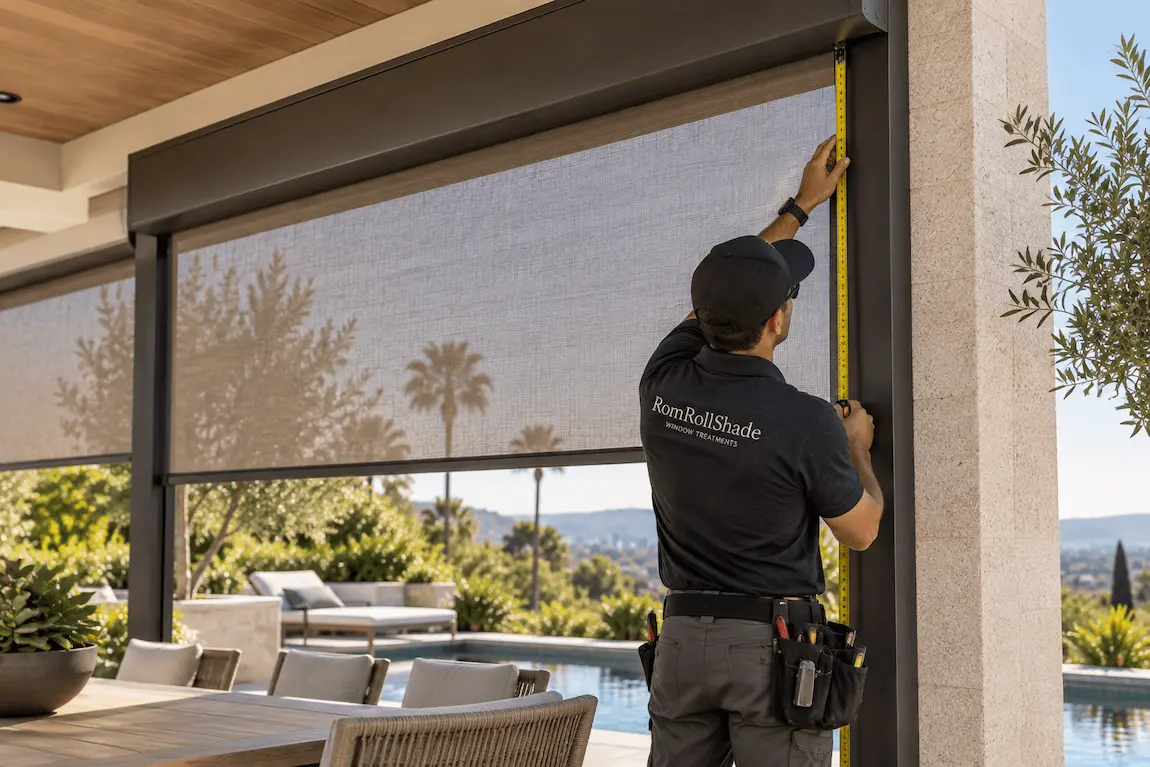
How Are Outdoor Shades Measured?
Exterior installations require more than measuring the width and height of an opening.
A professional installer also needs to consider:
- Mounting surfaces
- Structural attachment points
- Clearances
- Side-channel locations
- Roller and cassette dimensions
- Bottom-bar travel
- Nearby doors or furniture
- Exposure to wind
- Electrical access for motorization
This is particularly important on custom homes, where openings may appear symmetrical but differ slightly in actual dimensions.
RomRollShade provides professional window treatment installation in Los Angeles, including measurement and installation for custom projects.
How Much Do Outdoor Shades Cost?
There is no meaningful one-price answer for custom exterior shades.
Cost can vary based on:
- Width and height
- Number of shades
- Fabric
- Openness
- Guided vs. unguided system
- Cassette or housing
- Mounting complexity
- Manual vs. motorized operation
- Motor and control system
- Installation conditions
A small manually operated patio shade and a large motorized multi-panel installation are fundamentally different projects.
That is why accurate pricing usually requires measurements and a discussion about the way the outdoor area will be used.
For homeowners planning several window-treatment upgrades at the same time, it can also make sense to consider outdoor shades alongside interior roller shades, drapery, or motorized treatments during one consultation.
Outdoor Shades vs. Patio Enclosures
Outdoor shades and permanent patio enclosures serve different purposes.
An enclosure fundamentally changes the space.
An outdoor shade remains retractable.
When raised, the patio can remain completely open.
When lowered, you gain additional protection from sun, glare, and exposure.
For many homeowners, that flexibility is the main attraction.
You can adapt the space throughout the day rather than permanently closing it in.
Are Outdoor Shades Worth It?
For the right space, they can make a surprisingly large difference.
If a patio already exists but is rarely used because the afternoon sun is too intense, exterior shading may allow the homeowner to use an area they already paid to build.
Outdoor shades are particularly worth considering when:
- Direct sun limits patio use
- You want more daytime privacy
- Glare affects outdoor entertainment
- You want to preserve an outdoor view
- The opening is too large for a simple umbrella
- You want a retractable rather than permanent solution
The key is choosing the correct system for the actual conditions.
Outdoor Shades for Los Angeles Homes
Outdoor living is a major part of Southern California architecture, but the best outdoor spaces have to work throughout the day—not just when the sun happens to be in the right position.
A properly selected exterior shade can help a patio, pergola, or outdoor room remain more comfortable while preserving the open character that made the space appealing in the first place.
RomRollShade provides custom outdoor shades in Los Angeles, including professional consultation, measurement, system selection, motorization options, and installation throughout the San Fernando Valley and West Los Angeles.
Ready to Make Your Patio More Comfortable?
If direct sun, glare, or privacy is limiting the way you use your outdoor space, the first step is understanding what type of exterior shade will actually work for the opening.
RomRollShade can evaluate the space, recommend the appropriate fabric and system, measure the opening, and professionally install the finished shade.
Call (818) 216-4210
FAQ
What are outdoor shades called?
Outdoor shades may also be called exterior shades, patio shades, outdoor roller shades, exterior roller shades, exterior solar shades, or patio roller shades. The terminology varies, but all generally refer to shade systems designed for exterior applications.
Can outdoor shades reduce heat on a patio?
They can help reduce direct solar exposure and glare, which may make a sunny patio or covered outdoor space more comfortable. The result depends on the fabric, openness, orientation, and amount of direct sunlight.
Are outdoor shades good for pergolas?
Yes. Vertical outdoor shades are commonly used along the sides of pergolas to control low-angle sunlight and add privacy while keeping the structure open and retractable.
Can outdoor shades be motorized?
Yes. Motorized outdoor shades are especially useful for wide or tall openings and frequently used patio areas. Control options can include remotes, wall switches, apps, schedules, and compatible smart-home systems.
Can you see through outdoor solar shades?
Usually, yes, depending on the fabric openness. More open fabrics maintain better outward visibility, while tighter fabrics generally provide stronger solar control and privacy.
Do outdoor shades work in windy locations?
Exterior systems are designed for outdoor environments, but different products have different operating limits. Exposed locations may require guided systems, side channels, or other hardware appropriate to the installation.
