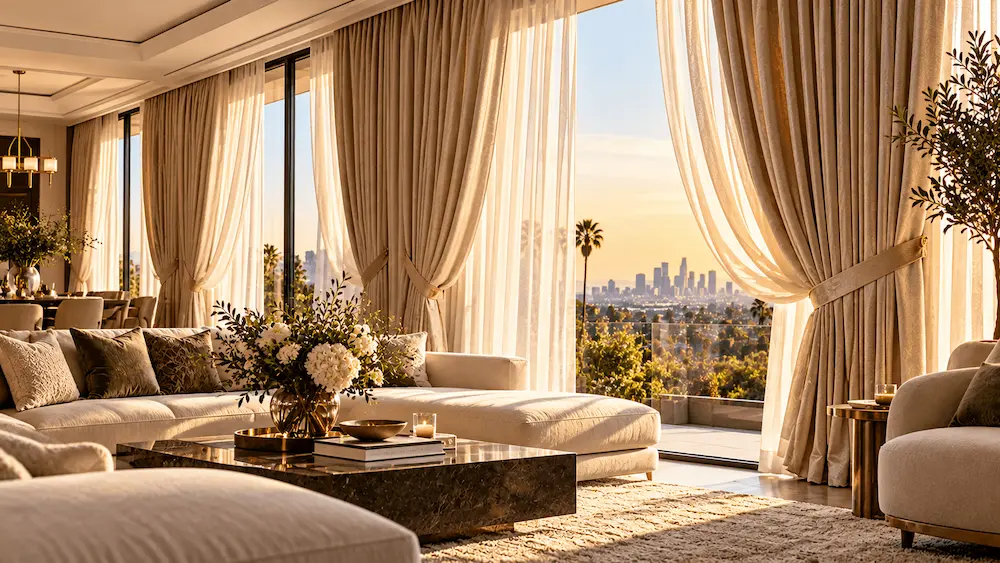
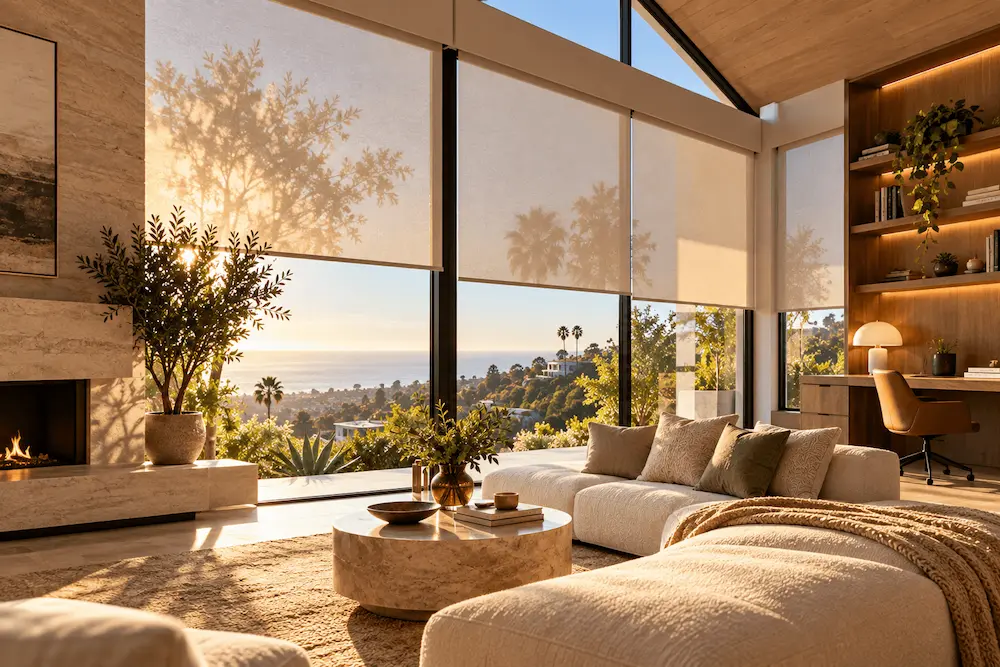
Los Angeles homeowners love natural light. From contemporary residences in Beverly Hills to coastal properties in Santa Monica and hillside homes overlooking the city, expansive windows are among the most desirable features of Southern California architecture.
But beautiful windows can also create everyday challenges.
Intense afternoon sunlight can make living rooms uncomfortable, produce distracting reflections on television screens, and expose furniture, flooring, and artwork to prolonged UV radiation.
The challenge is finding a window treatment that controls sunlight without completely hiding the outdoor scenery.
That’s where solar shades offer a practical and elegant solution.
Unlike traditional blackout shades, solar shades use specially woven fabrics designed to filter incoming sunlight while maintaining varying degrees of visibility to the outside.
For homeowners who want to enjoy their windows rather than cover them completely, custom solar shades can provide an appealing balance of comfort, functionality, and contemporary design.
In this guide, we’ll explore how solar shades work, explain the differences between fabric openness levels, compare solar and blackout shades, and help you choose the right solution for your Los Angeles home.
Why Solar Shades Are Ideal for Sunny Los Angeles Homes
Los Angeles is known for its sunshine, open architecture, and strong connection between indoor and outdoor living.
Large windows, sliding glass doors, and panoramic views are common features in homes throughout the region.
However, these architectural elements can also allow substantial sunlight into interior spaces, especially during the afternoon.
Solar shades are designed to address several of these challenges while preserving the appearance of modern windows.
Reduce Harsh Sunlight Without Making Rooms Feel Closed Off
One of the biggest advantages of solar shades is their ability to filter sunlight without necessarily creating a dark room.
Traditional opaque window coverings can significantly reduce the amount of natural light entering a space.
Solar screen fabrics work differently.
Their woven construction allows a controlled amount of light and visibility through the material, depending on the fabric’s openness, color, and optical properties.
This makes solar shades particularly attractive for living rooms, dining areas, and spaces where natural light is an important part of the interior design.
Imagine enjoying the afternoon in your living room without constantly adjusting your seating position to avoid direct sunlight.
With properly selected solar shades, you can soften incoming light while maintaining a visual connection to the outdoors.
For homeowners exploring different fabric options, light-filtering window shades are another solution worth considering.
Although light-filtering shades and solar shades can serve similar purposes, solar screen fabrics are specifically designed to offer varying degrees of view-through.
Minimize Glare on TVs, Computers, and Reflective Surfaces
Glare is one of the most common sunlight-related problems in modern homes.
Large windows can create reflections on television screens, computer monitors, polished countertops, and other reflective surfaces.
This is especially noticeable in rooms with west-facing windows, where low-angle afternoon sunlight can enter directly.
Solar shades help reduce the intensity of incoming sunlight, making these spaces more comfortable for everyday activities.
For example, a living room with large west-facing windows may benefit from a tighter solar screen fabric that provides stronger glare control.
A home office with a scenic view may require a different balance between glare reduction and outdoor visibility.
The ideal choice depends on the window orientation, the activities taking place in the room, and the homeowner’s priorities.
If afternoon sunlight is a recurring problem, our guide to window treatments for west-facing windows in Los Angeles explores additional solutions.
Help Protect Furniture, Flooring, and Interior Finishes
Sunlight contributes to fading and deterioration in many interior materials.
Over time, UV exposure can affect upholstered furniture, wood flooring, rugs, artwork, and decorative finishes.
Many solar screen fabrics are designed to reduce UV transmission, helping limit this exposure.
However, UV protection varies by fabric construction, openness, color, and manufacturer specifications.
A lower openness percentage generally provides a tighter weave, but openness alone should not be treated as an exact measurement of UV protection.
Homeowners should review the manufacturer’s tested UV transmission or rejection specifications when selecting fabrics.
For properties with valuable furnishings or extensive sun exposure, this can be an important consideration.
Complement Contemporary Los Angeles Architecture
Solar shades are particularly well suited to modern and minimalist interiors.
Their clean lines and streamlined appearance allow architectural details to remain the focal point.
Unlike more decorative window treatments, solar roller shades can blend into the surrounding design without competing with furniture, artwork, or scenic views.
Popular applications include:
- Contemporary living rooms with floor-to-ceiling windows
- Modern kitchens and dining spaces
- Home offices with large glass openings
- Condominiums overlooking the city
- Coastal homes with ocean-facing windows
- Open-concept homes with sliding glass doors
For homeowners seeking a coordinated appearance throughout their property, solar shades can also be combined with other custom window treatments.
The result is a window design that feels intentional rather than purely functional.
Understanding Solar Shade Openness Factors: 1%, 3%, 5%, and 10%
Choosing the right solar shade fabric is one of the most important decisions in the entire process.
One specification homeowners should understand is the openness factor.
The openness factor describes the approximate percentage of open space within the woven fabric.
For example, a fabric with 5% openness has approximately 5% open area between its yarns.
Generally, lower openness means a tighter weave, stronger glare control, and less visibility through the material.
Higher openness usually provides a clearer outdoor view but allows more sunlight to pass through.
However, the actual performance also depends on fabric color, weave construction, and material properties.
1% Openness: Strong Sunlight and Glare Control
A 1% openness solar shade has a very tightly woven construction.
It is often considered for windows where controlling intense sunlight is more important than maintaining a perfectly clear outdoor view.
Potential applications include:
- West-facing living rooms
- Home offices with strong afternoon glare
- Windows receiving prolonged direct sunlight
- Rooms where additional daytime privacy is desirable
A 1% fabric can significantly reduce direct visual exposure through the shade.
However, the outdoor view will generally appear more muted than it would through a more open fabric.
For homeowners dealing with particularly challenging sunlight, this trade-off may be worthwhile.
3% Openness: A Balance of Visibility and Sun Control
A 3% openness fabric offers a useful compromise between glare reduction and outward visibility.
It can be an attractive option for homeowners who want meaningful sunlight control without making their windows feel completely covered.
This openness level is often suitable for living rooms, home offices, and multipurpose spaces.
For example, a homeowner in Encino with large afternoon-facing windows might prefer a 3% fabric to reduce distracting glare while preserving a partial view of the backyard.
The final appearance will depend on the fabric color and lighting conditions.
5% Openness: A Popular Choice for View-Oriented Spaces
A 5% openness fabric allows more visibility through the shade than tighter 1% or 3% alternatives.
It can provide an appealing balance for rooms where the outdoor view is an important design feature.
Consider a living room in Pacific Palisades with expansive windows overlooking a garden or scenic landscape.
The homeowner may want to soften incoming sunlight while preserving the visual connection between the interior and exterior.
A 5% solar shade can be a strong candidate for that application.
It is important to remember, however, that greater openness generally means less glare control and less daytime privacy.
10% Openness: Prioritizing the Outdoor View
A 10% openness fabric has a more open weave.
This allows greater visibility through the shade and generally creates a brighter appearance.
It may be appropriate for windows where preserving the view is the primary objective and direct sunlight is less problematic.
Potential applications include:
- Windows with limited direct sun exposure
- Scenic hillside properties
- Living spaces overlooking landscaped gardens
- Rooms where maximum outward visibility is preferred
A 10% fabric will generally provide less glare reduction than a tighter weave.
For this reason, it may not be the best option for every west-facing window or television room.
Which Openness Factor Is Best?
There is no single openness percentage that works perfectly for every Los Angeles home.
The right choice depends on several factors:
Window orientation: South- and west-facing windows may experience more challenging direct sunlight during certain hours.
Outdoor views: A scenic ocean or hillside view may justify choosing a more open fabric.
Room function: A home office may require stronger glare control than a casual sitting area.
Privacy expectations: Properties close to neighboring homes may benefit from additional privacy treatments.
Fabric color: Darker and lighter fabrics can produce noticeably different viewing experiences, even with the same openness percentage.
For many homeowners, comparing physical fabric samples at the actual window is the most reliable way to understand these differences.
A professional consultation can help determine which combination of openness, fabric color, and shade configuration best suits the room.
Solar Shades vs. Blackout Shades: Privacy, Visibility, and Light Control
Solar shades and blackout shades are both popular window treatment options, but they serve different purposes.
Understanding these differences can help homeowners avoid choosing a product that doesn’t meet their expectations.
Solar Shades: Designed for Daylight and View Preservation
Solar shades are primarily intended to manage sunlight, glare, and visibility.
Their woven construction allows homeowners to maintain varying degrees of outward visibility during daylight hours.
This makes them particularly useful in living rooms, dining areas, and other spaces where maintaining a connection to the outdoors is desirable.
However, solar shades have an important limitation.
They should not be relied upon for complete nighttime privacy.
When interior lights are on after dark, people outside may be able to see silhouettes, movement, or details through the fabric.
The degree of visibility depends on the openness, fabric construction, lighting, and distance from the window.
For bedrooms, bathrooms, and other privacy-sensitive spaces, a second window treatment may be necessary.
Blackout Shades: Designed for Darkness and Privacy
Blackout shades use opaque materials intended to block light transmission through the fabric.
They are commonly selected for bedrooms, nurseries, media rooms, and spaces where darkness is a priority.
Unlike solar shades, blackout fabrics do not preserve the outdoor view when lowered.
They are designed to create a more enclosed environment.
It’s also important to distinguish blackout fabric from a completely lightproof installation.
Light can still enter around the edges of a shade unless the installation includes suitable overlaps, side channels, or other light-control features.
For homeowners prioritizing restful sleep, blackout roller shades may be a more appropriate choice.
Can You Combine Solar Shades and Blackout Shades?
Absolutely.
Combining different window treatments can provide greater flexibility throughout the day.
For example, a homeowner might use solar shades during daylight hours to reduce glare while maintaining outdoor views.
In the evening, a separate blackout or privacy treatment can provide additional coverage.
Possible configurations include:
- Dual roller shade systems
- Solar shades paired with custom drapery
- Solar shades combined with separate privacy shades
- Different shade fabrics selected for different rooms
These combinations can be especially useful in homes where a single room serves multiple purposes.
A living room might function as a bright gathering space during the day and a private entertainment area at night.
The right combination allows the window treatments to adapt to both situations.
Are Solar Shades Energy Efficient?
Solar shades can contribute to improved indoor comfort by reducing solar radiation entering through windows.
Depending on the fabric and installation, this may help reduce unwanted solar heat gain.
However, the level of thermal performance varies considerably.
Factors include fabric color, solar reflectance, openness, glazing characteristics, window orientation, and whether the shading system is installed inside or outside.
For homeowners primarily concerned about cooling costs, it is important to evaluate the complete window system rather than assuming that every solar shade provides the same energy savings.
Our article about energy-efficient window shades explains additional considerations for improving comfort through window treatments.
Choosing Custom Solar Shades for Large Windows and Scenic Views
Large windows are one of the defining architectural features of many Los Angeles homes.
Whether overlooking the Pacific Ocean, a landscaped backyard, or the surrounding hills, these windows are often central to the property’s design.
Selecting the right solar shades requires careful attention to both appearance and functionality.
Consider the Size and Configuration of Your Windows
Oversized windows require accurate measurements and appropriate hardware.
Depending on the window dimensions and fabric specifications, a single large shade may not always be practical.
Some installations may require multiple shades positioned side by side.
Other applications may benefit from coordinated motorized systems.
The best configuration depends on the window dimensions, available mounting space, fabric limitations, and desired appearance.
Professional measuring is particularly valuable for large windows because small inaccuracies can affect alignment and operation.
Choose Fabric Colors That Complement Your Interior
Solar shade fabrics are available in a variety of colors and textures.
Popular choices for contemporary Los Angeles interiors include warm white, soft gray, beige, charcoal, and natural-looking woven finishes.
However, fabric color affects more than aesthetics.
Darker solar screen fabrics often provide clearer outward visibility during daylight hours because they create less reflected glare toward the viewer.
Lighter fabrics may reflect more incoming solar radiation, depending on their construction, but can make the outdoor view appear less distinct.
Neither option is automatically superior.
The ideal choice depends on the home’s interior palette, sunlight exposure, and the homeowner’s priorities.
For example, a warm neutral fabric may complement a contemporary Brentwood living room, while a darker screen could be preferable where a crisp outdoor view is especially important.
Consider Motorized Solar Shades for Convenience
Motorization can make solar shades more convenient, especially when covering large or difficult-to-reach windows.
Instead of manually adjusting each shade, homeowners can operate compatible systems using a remote control, wall switch, or supported smart home integration.
Some systems also support scheduled operation.
For example, shades can be programmed to lower during periods of intense afternoon sunlight.
This can be particularly useful for homeowners with multiple windows exposed to the same direction.
Motorized solar shades can also create a cleaner appearance by eliminating the need for traditional operating cords.
If you’re considering automation, explore our guide to smart motorized shades to learn more about available control options.
Match Your Solar Shades to Your Lifestyle
The best solar shades are not necessarily the darkest, lightest, or most expensive.
They are the shades that solve the specific challenges of your home.
A family in Woodland Hills may prioritize reducing afternoon glare in a busy living room.
A homeowner in Santa Monica may prefer maintaining a beautiful coastal view.
Someone working from home in Encino may need consistent screen visibility throughout the day.
These different priorities can lead to different fabric selections, even when the windows are similar in size.
That’s why choosing solar shades should begin with understanding how each room is used.
Professional Measuring and Installation Matter
Custom solar shades should fit the window accurately and operate smoothly.
Important installation considerations include:
- Window dimensions and mounting depth
- Inside-mount versus outside-mount installation
- Fabric width limitations
- Roller and hardware selection
- Light gaps around the shade
- Motorization requirements
- Alignment across multiple windows
For larger installations, these details can have a significant impact on the finished appearance.
A professionally planned installation helps ensure the shades complement the architecture rather than distracting from it.
At RomRollShade, we help Los Angeles homeowners explore custom window treatment solutions suited to their spaces, design preferences, and everyday needs.
Create a More Comfortable Home Without Sacrificing the View
Beautiful windows should be enjoyed.
The right solar shades allow homeowners to manage sunlight while preserving the architectural openness that makes Southern California homes so appealing.
Whether you’re furnishing a contemporary home in Beverly Hills, updating a coastal property in Santa Monica, or improving a sun-filled living room in Encino, custom solar shades offer a sophisticated approach to everyday light control.
The key is choosing the right combination of fabric openness, color, window configuration, and operation.
With thoughtful planning, solar shades can transform sun-filled rooms into more comfortable, functional, and visually appealing spaces without sacrificing the views that make Los Angeles homes so special.
Why Choose RomRollShade for Custom Solar Shades in Los Angeles?
Every home has different lighting conditions, architectural features, and privacy requirements. Choosing the right solar shades involves more than selecting a fabric color or openness percentage.
At RomRollShade, we understand that beautiful window treatments should combine practical performance with thoughtful design.
Our custom window treatment solutions are tailored to your home’s unique dimensions, interior style, and everyday needs.
Personalized Window Treatment Consultations
Whether you’re dealing with intense afternoon glare, oversized windows, or a desire to preserve your outdoor views, selecting the right window coverings starts with understanding your space.
We help homeowners explore suitable fabric options, openness levels, colors, and operating systems based on their priorities.
Custom Solutions for Modern and Luxury Homes
From contemporary residences in Beverly Hills to coastal properties in Santa Monica and spacious family homes in Encino, different architectural styles call for different approaches.
Our selection of custom roller shades offers homeowners options for achieving a clean, sophisticated appearance while addressing their lighting and privacy needs.
For properties with large windows or hard-to-reach installations, motorized window treatments may provide additional convenience and control.
Professional Measuring and Installation
Even the most beautiful solar shade fabric needs to be properly measured and installed to achieve the desired result.
Our services include professional measuring and installation, helping homeowners achieve a clean, coordinated appearance across their windows.
We proudly serve homeowners throughout Greater Los Angeles, including Beverly Hills, Santa Monica, Pacific Palisades, Brentwood, Encino, Sherman Oaks, Woodland Hills, and surrounding communities.
Frequently Asked Questions About Solar Shades
Can You See Outside Through Solar Shades?
Yes. Solar shades are specifically designed to allow varying degrees of outward visibility while filtering incoming sunlight.
The clarity of the view depends on the fabric’s openness percentage, color, weave, and lighting conditions.
Generally, a 5% or 10% openness fabric offers greater outward visibility than a 1% fabric.
However, the best choice depends on how much sunlight control and privacy you need.
Do Solar Shades Provide Privacy at Night?
Solar shades should not be considered a reliable solution for complete nighttime privacy.
When interior lights are brighter than the outdoor environment, people outside may be able to see through certain solar screen fabrics.
For bedrooms, bathrooms, or other privacy-sensitive spaces, consider combining solar shades with blackout shades, privacy shades, or custom drapery.
What Is the Best Solar Shade Openness for Los Angeles Homes?
There is no universal answer.
A 1% or 3% openness fabric may be suitable for windows exposed to intense afternoon sunlight, while a 5% or 10% fabric may be preferable when preserving the outdoor view is the primary concern.
Window orientation, fabric color, room function, and privacy requirements should all influence the decision.
Are Solar Shades Better Than Regular Roller Shades?
Solar shades are a type of roller shade designed with screen fabrics that provide varying degrees of visibility and sunlight control.
Traditional roller shades may use light-filtering, room-darkening, or blackout fabrics.
Solar shades are particularly useful when reducing glare while maintaining some outward visibility is important.
The better option depends on the intended use of the room.
Can Solar Shades Be Motorized?
Yes. Many solar shade systems are available with motorized operation.
Depending on the selected hardware, homeowners may be able to control their shades using a remote, wall switch, or compatible smart home system.
Motorization is particularly convenient for large windows, tall installations, and rooms with multiple shades.
Schedule Your Custom Solar Shade Consultation in Los Angeles
Your windows should enhance your home’s beauty—not make your living spaces uncomfortable.
Whether you’re looking to reduce afternoon glare, protect interior furnishings from sunlight exposure, or maintain a beautiful outdoor view, custom solar shades can offer an elegant and practical solution.
At RomRollShade, we help homeowners find window treatments that balance natural light, privacy, comfort, and contemporary design.
From fabric selection to professional measuring and installation, our goal is to help you create windows that look beautiful and work for your lifestyle.
Ready to explore custom solar shades for your Los Angeles home?
Contact RomRollShade today to discuss your project and discover the right window treatment solution for your space.
Call (818) 216-4210 to schedule your personalized consultation.
RomRollShade — Beautiful Windows. Better Living.