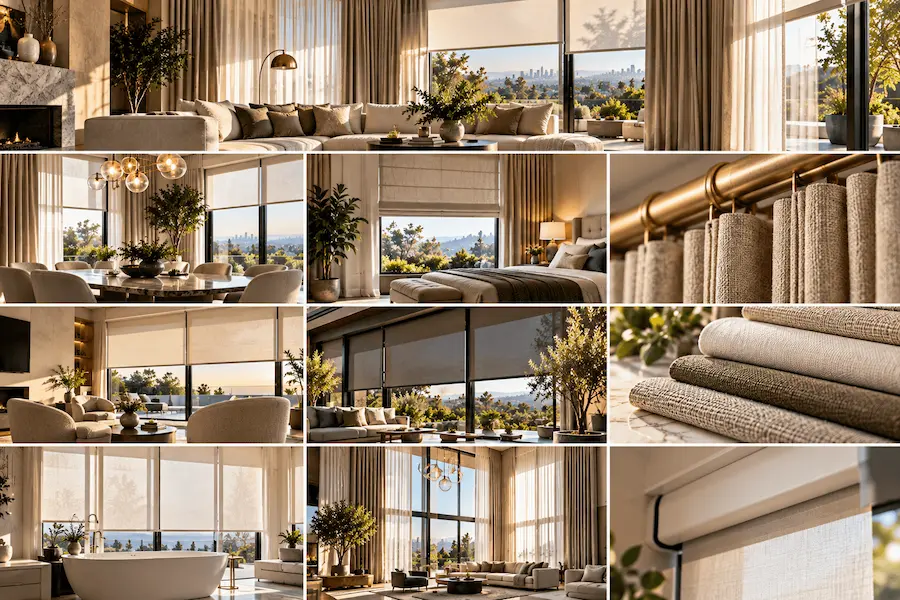
Window treatments have changed significantly over the past several years. What was once considered a simple choice between blinds, shades, and curtains now includes smarter operating systems, cleaner designs, and an increased focus on safety.
One of the most important changes is the move toward cordless window treatments.
For Los Angeles homeowners, going cordless is not simply about removing a dangling cord. A well-designed cordless system can create a cleaner appearance, make a shade easier to operate, improve safety in homes with young children, and make large or hard-to-reach windows much more practical.
But “cordless” can describe several different types of window treatments. A manually operated cordless roller shade and a fully automated motorized shade, for example, solve some of the same problems in very different ways.
Understanding those differences can help you choose a system that works not only with your windows, but also with the way you actually use your home.
What Are Cordless Window Treatments?
A cordless window treatment is designed to operate without a traditional accessible operating cord hanging beside the window.
Depending on the product, the treatment may be operated by gently raising or lowering the shade by hand, using a wand or other approved operating mechanism, or by using a motor controlled through a remote, wall switch, app, or compatible smart-home system.
The result is a window that looks less cluttered and, importantly, eliminates the traditional dangling operating cord when a truly cordless system is used.
Cordless operation is available across many modern custom window treatments, although the exact operating options depend on the product, size, fabric, hardware, and installation.
For homeowners, the important question is therefore not simply:
“Can I get this shade without a cord?”
A better question is:
“Which cordless operating system makes the most sense for this particular window?”
That distinction becomes especially important when dealing with large windows, tall openings, sliding doors, nurseries, bedrooms, or windows that are adjusted several times throughout the day.
Why Window-Covering Cords Have Become a Safety Concern
The move toward cordless window coverings is not merely a design trend.
Accessible window-covering cords can create a serious strangulation hazard for young children. The U.S. Consumer Product Safety Commission (CPSC) recommends cordless window coverings in homes where young children live or visit and identifies cordless products as the safest option for eliminating the strangulation hazard associated with operating cords.
Safety standards for window coverings have also changed substantially.
The revised ANSI/WCMA A100.1-2022 standard, which took effect for products manufactured beginning June 1, 2024, significantly expanded cordless requirements and restrictions. Among other changes, the revised standard eliminates free-hanging operating cords and free-hanging tilt cords from made-to-order custom window coverings, while certain product categories can use specific alternative operating systems that meet applicable requirements.
The Window Covering Safety Council provides additional information about these updated standards and the industry’s transition toward cordless and inaccessible-cord designs.
For homeowners, however, the practical takeaway is simpler: if you are replacing older window treatments—especially in a home where children live or regularly visit—cordless options deserve serious consideration.
Cordless Does Not Mean Only One Thing
One of the biggest misconceptions about cordless window treatments is that they all operate the same way.
They don’t.
There are two broad approaches homeowners will encounter most often.
Manual Cordless Shades
A manual cordless shade uses a mechanism that allows you to physically raise or lower the shade without pulling a hanging operating cord.
On an appropriately sized window, this can be beautifully simple.
You reach the bottom rail or hem bar, move the shade to the desired position, and the mechanism holds it there.
Manual cordless operation can be an excellent choice when:
- The window is comfortably within reach
- The shade is not unusually large or heavy
- You want a simple operating system
- You do not need remote or automated control
- You want to keep the project more budget-conscious
For many everyday windows, manual cordless operation provides exactly what is needed without adding unnecessary technology.
Motorized Window Treatments
Motorization takes the cordless concept further.
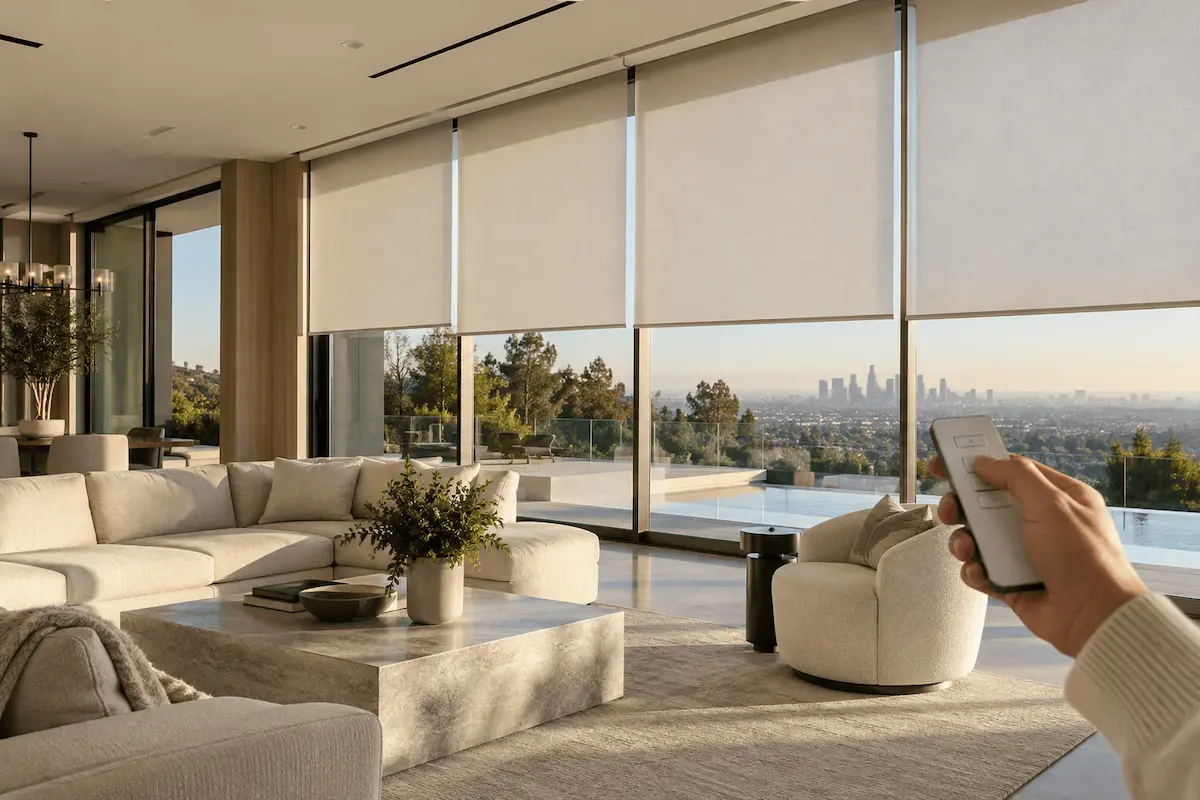
Instead of manually moving the treatment, a small motor operates it for you. Depending on the system, control may be available through a remote, wall control, app, schedule, or compatible smart-home integration.
Modern motorized window treatments can be particularly useful for large windows, tall windows, multiple shades in the same room, and treatments that are opened and closed frequently.
Motorization also removes the need to physically reach the shade at all.
For the right window, that is not just a luxury. It can fundamentally improve how useful the window treatment is every day.
Manual Cordless vs. Motorized: Which Is Better?
Neither option is automatically better.
The correct choice depends on the window.
Imagine a standard bedroom window that is easily accessible. A quality manual cordless shade may operate beautifully and provide little reason to add a motor.
Now imagine a two-story living room with shades mounted well above comfortable reach.
Manual operation becomes inconvenient or even impractical. Motorization suddenly makes much more sense.
The same is true for a wall containing several shades. Opening six shades individually every morning and closing them every evening may quickly become tedious. A properly configured motorized system can allow several treatments to move together.
The decision should therefore consider:
Window height. Can you comfortably reach the treatment?
Window size. Larger shades may be more practical to motorize.
Frequency of use. A shade adjusted several times every day benefits more from convenient operation than one that rarely moves.
Number of treatments. Coordinating multiple shades can make motorization particularly useful.
Lifestyle. Some homeowners prefer simplicity; others value schedules, remote control, and smart-home integration.
Budget. Motorization adds cost, and it does not need to be installed on every window simply because it is available.
A thoughtful window-treatment plan can even combine both systems—manual cordless treatments where they make sense and motorized treatments where automation provides a meaningful advantage.
Cordless Roller Shades: Clean, Simple, and Versatile
For contemporary interiors, roller shades are one of the most natural applications for cordless operation.
Roller shades already have a minimal profile. Removing a visible operating cord or chain can make that profile even cleaner.
They also offer considerable flexibility in light control.
A living area may benefit from a light-filtering fabric that softens strong daylight while keeping the room bright. Bedrooms may require a denser room-darkening or blackout roller shade.
In sunny Southern California homes, the fabric selection matters just as much as the operating system. The right combination can help manage glare, privacy, daylight, and heat while maintaining a clean architectural appearance.
Cordless roller shades are especially worth considering for:
- Bedrooms
- Nurseries
- Living rooms
- Home offices
- Kitchens
- Modern and minimalist interiors
For larger openings or hard-to-reach installations, the same clean roller-shade design can often be paired with motorization.
What About Roman Shades?
Cordless design does not require a modern minimalist aesthetic.
Homeowners who prefer a softer, more decorative treatment can also consider custom Roman shades.
Roman shades use fabric that gathers into structured folds as the shade rises. They provide much of the practicality of a shade while bringing more textile character to the room.
Depending on the specific design and system, Roman shades can be configured with manual or motorized operation.
This makes them particularly attractive in spaces where homeowners want the visual warmth of fabric without returning to an older-style exposed operating cord.
A Roman shade can work especially well in:
- Bedrooms
- Dining rooms
- Formal living spaces
- Reading rooms
- Traditional or transitional interiors
Fabric, lining, shade size, mount type, and operating system all need to work together, so Roman shades benefit particularly from being specified as a complete system rather than choosing each component independently.
Cordless Window Treatments for Homes With Children
If young children live in or frequently visit the home, operating-system safety should become part of the initial window-treatment decision—not an afterthought.
Children naturally climb, explore, and interact with objects adults may barely notice. A cord beside a window can become accessible when a child climbs onto a bed, sofa, chair, or other nearby furniture.
The CPSC recommends installing cordless window coverings in rooms where children may be present.
This is particularly relevant for:
- Nurseries
- Children’s bedrooms
- Playrooms
- Family rooms
- Grandparents’ homes
- Guest rooms used by visiting families
It is also important to look beyond the obvious front-facing pull cord. Older window coverings can contain different types of accessible operating or inner cords.
Homeowners with older products can review the CPSC’s window covering cord safety guidance to understand the risks and recommended precautions.
If replacing an older treatment is practical, choosing an appropriately designed modern cordless system can address the issue at its source rather than relying solely on keeping a cord out of reach.
What About Pets?
Pets and children are obviously different safety considerations, and child-safety standards should not be casually generalized to animals.
However, removing dangling operating cords can still make the area around a window less cluttered for households with curious cats or active dogs.
Pets often spend time beside windows, climb onto window seats, or move behind drapery and shades. A clean operating system eliminates one more hanging object in that environment.
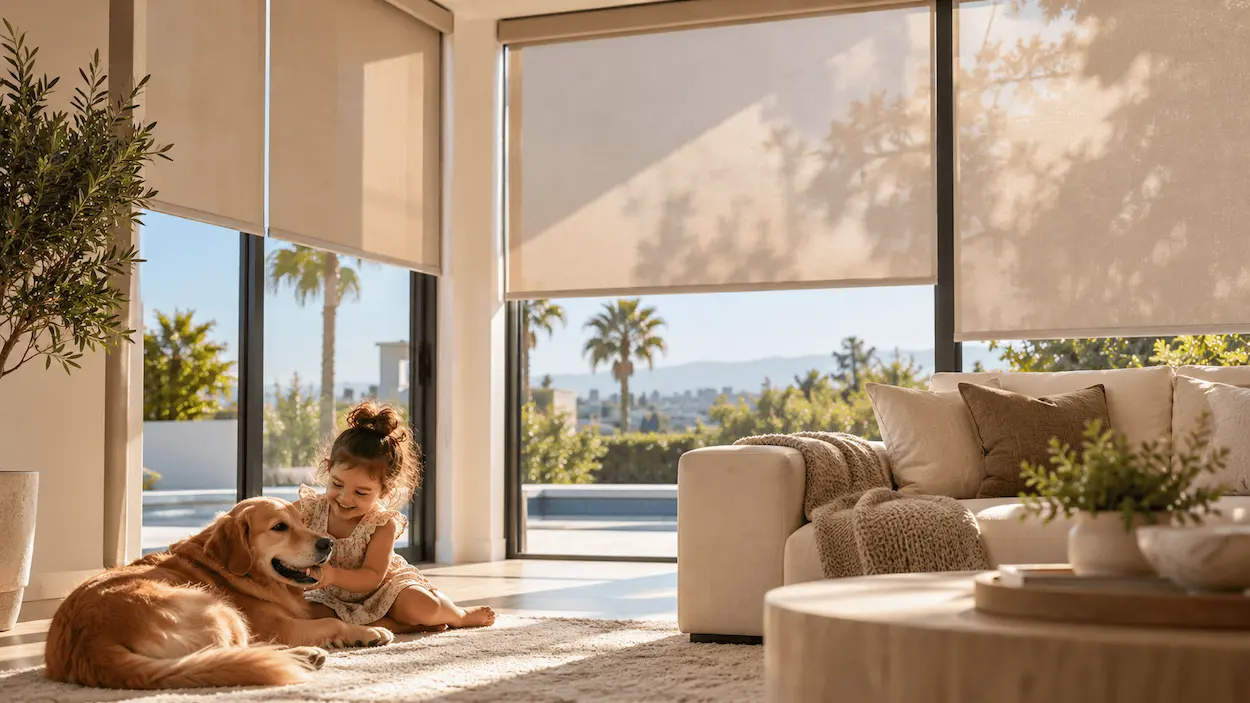
For a household with both children and pets, cordless design can therefore make the window area feel noticeably cleaner and simpler.
Cordless Shades for Bedrooms and Nurseries
Bedrooms are one of the strongest applications for cordless shades because privacy, light control, and ease of operation all matter.
For adults’ bedrooms, the choice may be primarily about convenience and appearance.
For a nursery or young child’s bedroom, safety becomes a major consideration as well.
A blackout roller shade can help create a significantly darker sleep environment, while cordless or motorized operation removes the need for a hanging operating cord.
There is an important detail here: choosing blackout fabric does not automatically make a room completely dark.
Light can still enter around the edges of a shade. If stronger room darkening is the goal, the mount, measurements, light gaps, side conditions, and surrounding architecture should all be considered.
This is one reason custom measurement matters. The fabric is only one component of the finished result.
Cordless Shades for Living Rooms
Living rooms often present a different problem.
Rather than maximum darkness, homeowners may want to control glare and privacy while preserving daylight.
In that situation, light-filtering shades can provide a useful balance.
A cordless light-filtering roller shade keeps the window visually clean while softening incoming light. If the windows are large or several shades need to move together, motorization can make the system much easier to use.
Los Angeles homes frequently have large glass areas designed around natural light and indoor-outdoor living. The goal should not necessarily be to cover that architecture. A good window treatment should allow you to control it.
Why Large Windows Change the Decision
The larger the window, the more important the operating system becomes.
A solution that works perfectly on a small bedroom window may not be the best solution for a wide living-room opening.
Large shades involve additional considerations:
- Overall shade weight
- Fabric behavior
- Tube and hardware requirements
- Mounting conditions
- Ease of manual operation
- Motor capacity when automated
- Alignment when multiple shades are installed side by side
For this reason, large windows are one of the situations where motorization can provide a meaningful functional advantage rather than simply adding another feature.
Instead of manually adjusting each treatment, shades can potentially be grouped and operated together.
That becomes particularly useful on wide window walls and in rooms where the shades are adjusted every morning and evening.
Tall and Hard-to-Reach Windows
Los Angeles architecture includes everything from compact apartments to hillside homes with high ceilings and expansive glazing.
When a window is above comfortable reach, a manual cordless mechanism may technically eliminate the cord but still leave a practical problem:
How do you operate it?
This is where motorized shades become especially useful.
The treatment can be positioned where it needs to be architecturally without requiring the homeowner to reach the bottom rail.
For high clerestory windows, tall stairwell glazing, or two-story spaces, motorization can turn a window treatment that would rarely be adjusted into something homeowners can actually use every day.
Cordless Does Not Have to Look “High-Tech”
Some homeowners hear the words “cordless” or “motorized” and imagine a visibly technological product.
That does not have to be the case.
The technology can remain largely hidden.
A motorized roller shade can still look like a simple roller shade. A motorized Roman shade can still read as a soft fabric treatment. And custom drapery and curtains can use a motorized track while preserving the appearance of traditional fabric panels.
The best motorization is often the motorization you barely notice.
You notice that the shade moves smoothly. You notice that the room becomes private in the evening. You notice that strong afternoon light can be controlled easily.
You do not necessarily need to notice the technology making it happen.
Can Cordless Shades Work With a Smart Home?
Many motorized systems can integrate with smart-home platforms, depending on the motor, controls, gateway, and automation ecosystem selected.
This can allow shades to become part of daily routines rather than isolated devices.
For example, compatible shades may be scheduled to open in the morning, adjust during periods of strong sun, and close in the evening for privacy.
But smart-home compatibility should be verified before products are ordered.
“Motorized” and “smart” are not automatically the same thing.
A motor may work perfectly from a dedicated remote without supporting the particular smart-home platform you use.
At RomRollShade, motorized projects are planned around the actual windows and the way the homeowner wants to control them. Our motorized window treatment systems include remote, app, scheduling, and compatible smart-home options where supported.
Should You Replace Older Corded Window Treatments?
Not every older shade needs to be replaced simply because a newer design exists.
However, accessible cords deserve particular attention when young children live in or visit the home.
The CPSC recommends replacing corded window coverings with cordless products in homes where children are present. When immediate replacement is not possible, the agency provides specific precautions intended to reduce risk, including keeping cords out of children’s reach, moving furniture and cribs away from windows, and properly anchoring applicable continuous-loop cords.
Those measures should not be interpreted as making every older corded treatment equivalent to a cordless one.
Homeowners can review the complete CPSC guidance for window covering cords before deciding how to handle existing products.
Outside child-safety considerations, replacement may also make sense when older treatments are difficult to operate, no longer fit correctly, have worn mechanisms, or simply no longer meet the room’s privacy and light-control needs.
Cordless vs. Corded: Appearance Matters Too
Safety and operation are important, but there is another reason cordless window treatments have become popular:
They look cleaner.
A carefully designed room can be visually disrupted by an unnecessary chain or cord running down one side of every window.
Removing that element allows the fabric, architecture, and window itself to become the focus.
This can be particularly effective in contemporary Los Angeles interiors where clean lines and large expanses of glass are part of the design.
Cordless operation can also complement more traditional rooms. A Roman shade or tailored drapery does not need visible technology to benefit from modern operation.
In other words, cordless design is not a style.
It is an operating approach that can work across many styles.
Choosing the Right Cordless Window Treatment
Instead of starting with a product name, start with the window and the room.
Ask:
How much privacy do we need?
A street-facing bedroom has different requirements from a second-story living room.
How much light should remain?
Some rooms need blackout performance. Others should remain bright while reducing glare.
Can we comfortably reach the window?
If not, motorization may be much more useful than a manual cordless system.
How large is the treatment?
Size and weight affect which operating systems are appropriate.
How often will we adjust it?
A treatment used twice every day should be easy to operate.
Are young children regularly present?
If so, cordless design should be prioritized, consistent with current safety guidance.
Do we want automation?
If schedules, grouped operation, remote control, or smart-home integration matter, plan for them before ordering the treatment.
These questions usually lead to a better result than choosing a product based solely on a showroom sample or photograph.