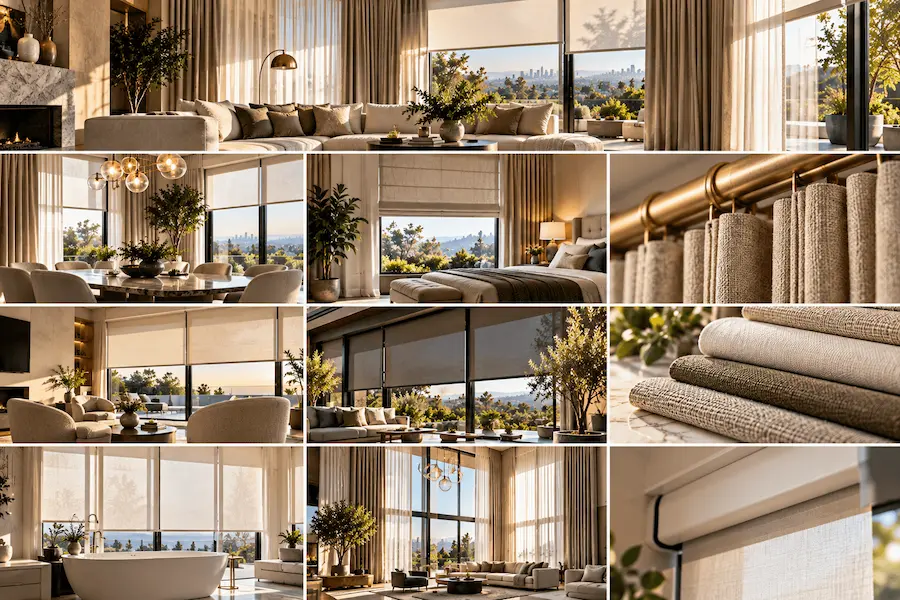
Sliding glass doors are practically made for the Southern California lifestyle.
They fill rooms with natural light, create expansive outdoor views, and connect living spaces with patios, balconies, pools, and backyards. But when it comes to window treatments, sliding doors can also be among the most challenging openings in a home.
A treatment that looks beautiful but makes it difficult to use the door quickly becomes frustrating. A treatment that provides privacy but completely hides the view may defeat one of the biggest reasons for having a sliding glass door in the first place.
And in Los Angeles, there’s another consideration: sunlight.
Large expanses of glass can expose a room to strong afternoon sun, glare, and changing privacy conditions throughout the day.
So what’s the best way to cover a sliding glass door?
There isn’t one universal answer. The right solution depends on the size of the opening, how frequently you use the door, the direction it faces, your privacy requirements, and the style of your home.
Here are some of the best options to consider.
What Makes Sliding Glass Doors Different?
Before choosing a treatment, it helps to understand why sliding doors need a different approach from ordinary windows.
A typical window is primarily something you look through. A sliding glass door is both a window and a traffic path.
You may open it dozens of times during a weekend while entertaining, letting pets outside, carrying food to the patio, or simply enjoying the California weather.
That means your window treatment needs to work around the way the door actually moves.
There are several factors to consider:
- Width and height of the opening
- Direction the door slides
- Available wall space beside the door
- Frequency of use
- Sun exposure
- Desired privacy
- Furniture placement
- Whether manual or motorized operation is preferred
For oversized openings, accurate measurement becomes particularly important.
A professionally planned custom window treatment can account for all of these factors rather than forcing a standard-size product onto an architectural opening it wasn’t designed for.
1. Custom Drapery: A Classic Choice for Sliding Glass Doors
One of the most versatile solutions for sliding doors is custom drapery.
There’s a practical reason drapery has been used over large glass doors for decades: it naturally moves in the same horizontal direction as the door itself.
When open, panels can stack to one or both sides of the opening. When closed, they can cover the entire glass surface.
But custom drapery offers much more than functionality.
Fabric adds softness and architectural presence to a room, which can be particularly effective when a large sliding door otherwise creates a broad, visually hard surface of glass.
Depending on the fabric and lining, drapery can provide different levels of:
- Privacy
- Light filtering
- Room darkening
- Glare reduction
- Decorative impact
For contemporary interiors, simple ripple-fold drapery can create clean vertical lines without feeling overly traditional.
For more formal rooms, pleated styles and richer fabrics can become an important part of the interior design itself.
The key is making sure the drapery is designed around the actual opening—not simply around the dimensions of the glass.
2. Motorized Curtains for Large Sliding Doors
Large glass doors are also one of the places where motorization can make the biggest practical difference.
With motorized curtain tracks, wide drapery panels can open and close without manually pulling fabric across a long opening.
This can be especially useful for:
- Extra-wide sliding doors
- Floor-to-ceiling glass
- Frequently adjusted drapery
- Hard-to-reach installations
- Multiple adjacent glass panels
- Homes where convenience and automation are priorities
Depending on the system, operation may be available through a remote, wall control, app, or compatible automation setup.
Imagine a large living room facing the backyard.
During the day, the curtains remain open to enjoy the view. As the afternoon sun becomes stronger, they can close to soften the light. In the evening, they provide privacy without requiring you to walk across the entire room and manually pull multiple heavy panels.
Motorization turns a large window treatment into something you’re more likely to use throughout the day.
3. Roller Shades for a Clean, Minimal Look
For homeowners who prefer a more minimal appearance, custom roller shades can also work for certain sliding glass door configurations.
Roller shades disappear visually more than full drapery, making them particularly attractive in contemporary Los Angeles interiors.
They can also be customized with fabrics offering different levels of light control.
A light-filtering material can soften direct sunlight while preserving the bright character of the room. A denser fabric can provide greater privacy and glare reduction.
However, door operation matters.
Because a roller shade travels vertically while a sliding door moves horizontally, the treatment needs to be planned carefully so it doesn’t interfere with frequent access.
For a very wide opening, dividing the treatment into multiple shades may sometimes provide better functionality than using one extremely large shade.
The correct configuration depends on the dimensions and architecture of the opening.
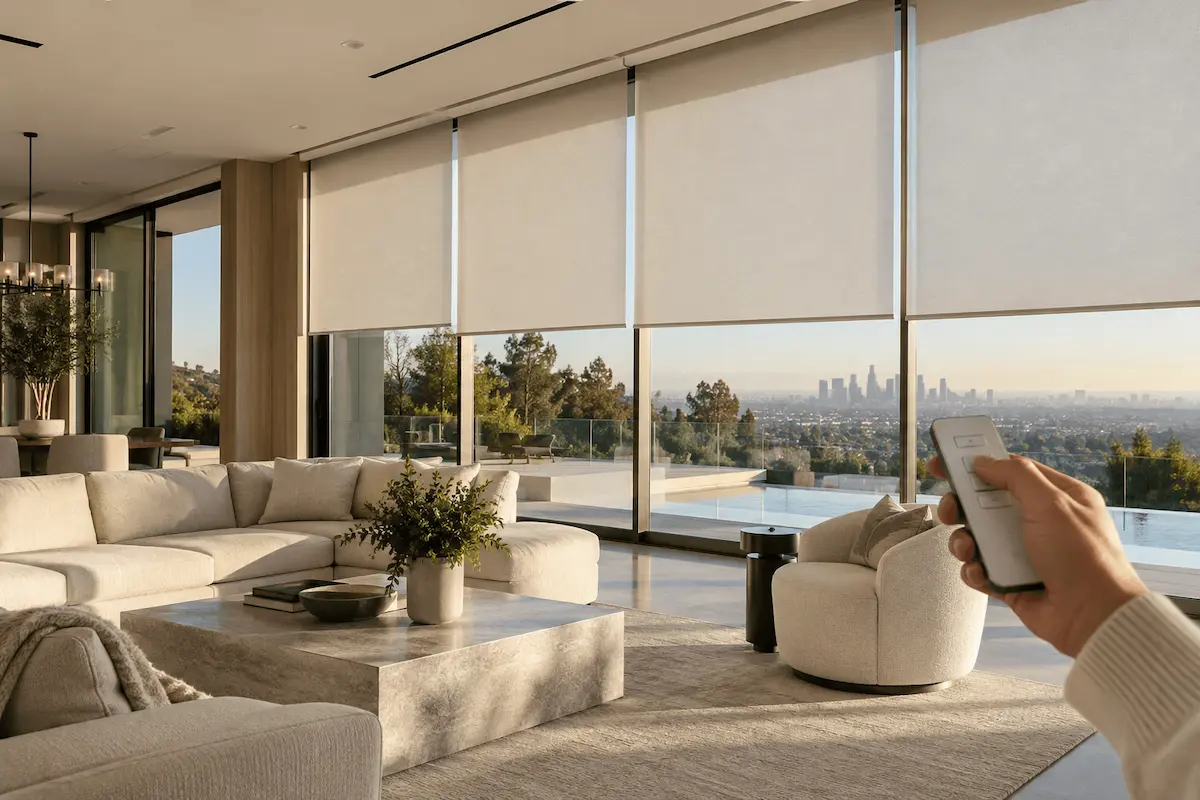
4. Motorized Roller Shades for Oversized Glass
Large sliding doors and expansive windows are also excellent candidates for motorized window treatments.
Instead of manually raising and lowering a large shade, motorization allows the treatment to operate with much less effort.
This becomes particularly useful when several shades cover a wall of glass.
For example, a modern Los Angeles home might have three adjacent glass sections overlooking a patio. Each section can have its own roller shade while the group maintains a clean, coordinated appearance.
Motorization can make controlling those shades much easier.
It also allows homeowners to respond more consistently to changing sunlight throughout the day.
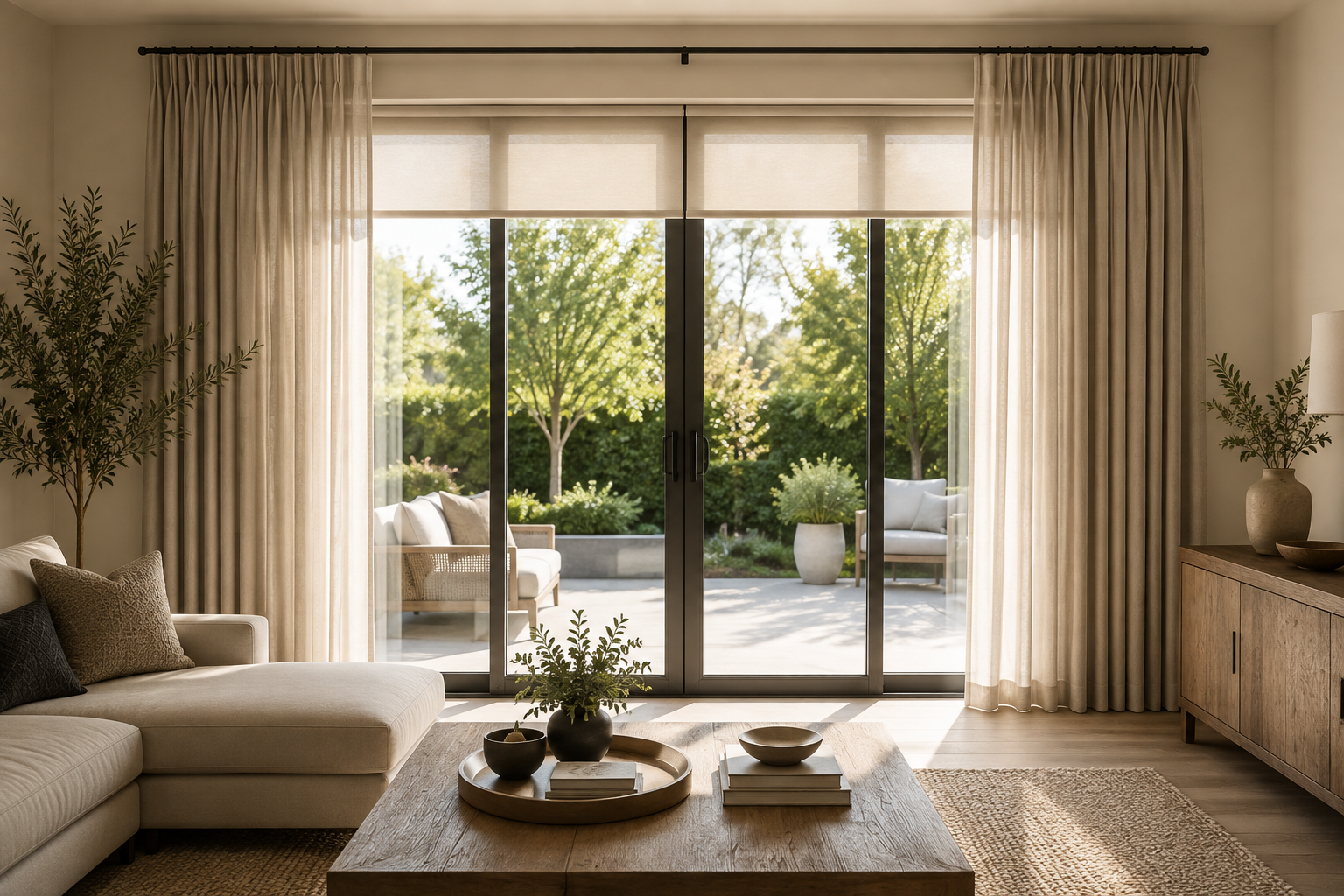
5. Layering Roller Shades and Drapery
Sometimes the best solution isn’t choosing between shades and curtains.
It’s using both.
Layering roller shades with custom drapery creates a flexible system that can handle different situations throughout the day.
The roller shade can provide everyday light management while maintaining a clean appearance.
The drapery can add:
- Additional privacy
- Greater room darkening
- Decorative softness
- Texture and color
- A finished architectural appearance
This approach works particularly well in living rooms, primary bedrooms, and larger designer-focused spaces.
It also gives homeowners much greater control than relying on one treatment to solve every problem.
What About Strong Los Angeles Sun?
Sliding glass doors can represent a very large area of exposed glass.
That’s particularly important for doors receiving direct afternoon sunlight.
According to the U.S. Department of Energy, window coverings can help manage solar heat gain and improve comfort when properly selected and used.
But fabric choice matters.
A beautiful decorative material isn’t automatically the right choice for a door exposed to hours of direct sunlight.
Before selecting a treatment, consider:
Which direction does the door face?
When does direct sunlight reach the glass?
Is glare the primary problem?
Do you want to preserve the outdoor view?
How much privacy do you need during the day and at night?
These answers help determine whether light-filtering fabric, stronger light control, lined drapery, or a layered solution makes the most sense.
Best Options by Room
Living Rooms
Living rooms usually benefit from flexibility.
Custom drapery, roller shades, or a layered combination can all work depending on the interior style.
If the sliding door is used frequently to reach a patio or backyard, easy operation should be a priority.
Bedrooms
Privacy and light control generally become more important.
Lined drapery, blackout-oriented shades, or a layered treatment can provide stronger coverage.
For bedrooms requiring significant room darkening, blackout roller shades may also be considered as part of the overall design.
Dining Rooms
Dining areas often benefit from light-filtering treatments that soften sunlight without making the room unnecessarily dark.
Drapery can also add visual height and create a more finished dining space.
Home Offices
Glare is frequently the main concern.
A carefully selected shade can help manage bright sunlight while still allowing useful natural light into the room.
Should Curtains Touch the Floor?
For most full-height sliding glass doors, properly designed drapery generally looks best when it relates intentionally to the floor.
The exact finished length depends on the desired style and practical requirements.
A tailored treatment may finish very close to the floor for a clean appearance, while certain decorative styles may use additional fabric.
For frequently used sliding doors, however, practicality matters.
Fabric that excessively pools in a high-traffic doorway may look dramatic but become inconvenient in everyday use.
Custom measurement allows the finished length to reflect both the design and how the door is actually used.
How Wide Should Curtains Be for a Sliding Glass Door?
This is where many ready-made treatments fall short.
The width of the glass itself is only part of the measurement.
You also need to consider where the fabric will go when the curtains are open.
If there’s sufficient wall space beside the door, the treatment may be designed so much of the fabric stacks beyond the glass. That can preserve more of the outdoor view when the curtains are open.
If wall space is limited, the configuration may need to change.
Hardware placement, fullness, fabric weight, stack-back, and the direction the door operates all affect the final design.
That’s why large sliding doors are one of the areas where professional measurement and installation can make a noticeable difference.
Choosing the Right Style for Your Los Angeles Home
Architecture varies dramatically throughout Los Angeles.
A contemporary home in Calabasas with an oversized wall of glass may call for a very different solution from a traditional home in Encino.
A condo in Studio City may have limited space around a balcony door, while a larger property in Sherman Oaks or Woodland Hills may have multiple sliding doors opening onto a backyard.
Homes in Beverly Hills may prioritize custom fabrics and integrated motorization as part of a larger interior design.
There shouldn’t be a one-size-fits-all recommendation.
The treatment should respond to the architecture.
Manual or Motorized: Which Should You Choose?
Manual treatments remain perfectly practical for many sliding doors.
Motorization becomes more compelling as the treatment gets larger, heavier, harder to reach, or more frequently adjusted.
Consider motorization if:
- Your sliding door is exceptionally wide
- You’re covering multiple glass panels
- You frequently adjust treatments throughout the day
- You want scheduled operation
- You prefer cleaner operation without handling fabric
- The project already includes other motorized window treatments
For some homes, motorization is primarily a convenience.
For others, it changes a large treatment from something that’s rarely adjusted into something that’s actually used every day.
Professional Measurement Matters More on Large Openings
Small errors become more noticeable as window treatments get larger.
A measurement error of half an inch may seem insignificant on paper, but large drapery installations and multi-shade configurations require careful alignment.
The mounting surface also needs to be considered.
With sliding doors, we look at more than width and height.
We consider:
- Door operation
- Handles and hardware
- Wall clearance
- Ceiling height
- Stack-back space
- Furniture placement
- Mounting conditions
- Electrical requirements for motorization
- Fabric behavior
The objective is to create a treatment that looks intentional and works naturally with the door.
Custom Sliding Door Window Treatments in Los Angeles
The best window treatment for a sliding glass door should do more than cover the glass.
It should make the room easier to use.
For some homes, that’s clean custom roller shades.
For others, it’s full-height drapery.
For oversized openings, motorized curtain tracks or motorized shades can add meaningful everyday convenience.
And for rooms requiring multiple levels of light control and privacy, layering shades and drapery may provide the most complete solution.
RomRollShade provides custom window treatments, professional measurement, and installation from our Van Nuys location for homeowners throughout Los Angeles and surrounding communities, including Sherman Oaks, Encino, Studio City, Woodland Hills, Calabasas, Beverly Hills, and nearby areas.
If you’re trying to decide what works best for a large sliding door, the easiest way to start is to evaluate the opening in the actual room.
Schedule an in-home window treatment consultation and we’ll help you compare the options for your space.
Frequently Asked Questions
What is the best window treatment for a sliding glass door?
Custom drapery, roller shades, and motorized treatments can all work well. The best option depends on the width of the door, how often it’s used, available wall space, desired privacy, sun exposure, and interior style.
Are roller shades good for sliding glass doors?
Yes, for many configurations. Roller shades provide a clean, minimal appearance and different levels of light control. Large openings may benefit from multiple coordinated shades rather than one oversized treatment.
Are curtains practical for sliding patio doors?
Yes. Drapery moves horizontally, making it naturally compatible with sliding doors. Properly designed panels can stack away from the opening when the door is in use and close for privacy or light control when needed.
Can sliding glass door curtains be motorized?
Yes. Motorized curtain tracks can be particularly useful for wide or frequently adjusted sliding-door treatments, allowing large drapery panels to open and close more conveniently.
Should I use blackout treatments on a sliding glass door?
It depends on the room. Bedrooms and media spaces may benefit from stronger room-darkening treatments, while living and dining areas often benefit from maintaining more natural daylight.
How do I choose between roller shades and drapery?
If you prefer a clean, minimal appearance, roller shades may be a better fit. If you want softness, texture, broad horizontal operation, and greater decorative impact, custom drapery may be preferable. In some rooms, combining both provides the greatest flexibility.
Frequently Asked Questions
What are the best window treatments for Los Angeles heat?
There isn’t one treatment that’s best for every home. Roller shades, blackout shades, lined Roman shades, and drapery can all help manage strong sunlight. The right option depends on window orientation, room use, desired daylight, privacy, and design.
Do blackout shades help with heat?
Dense blackout fabrics block direct sunlight through the material and can make bright, sun-exposed rooms more comfortable. However, overall thermal performance also depends on the window, installation, fit, and surrounding building conditions.
Should I choose blackout or light-filtering shades?
Choose blackout when darkness and strong light control are priorities, particularly in bedrooms and media rooms. Choose light-filtering treatments when you want to soften direct sunlight while preserving more natural daylight.
Are motorized shades useful for sunny windows?
Yes. Motorization can be especially useful for windows that receive strong sunlight at predictable times. Compatible systems can allow shades to operate by remote, app, or schedule so you don’t have to manually adjust every window throughout the day.
Can I combine roller shades with curtains?
Absolutely. Layering a roller shade with custom drapery gives you multiple levels of light control and privacy while also adding texture and softness to the room.
Does professional installation make a difference?
Yes, particularly with blackout, oversized, and motorized treatments. Accurate measurement and installation affect light gaps, alignment, operation, appearance, and how well the treatment fits the window.