Los Angeles homes get plenty of sunshine. That’s great for natural light, views, and bright interiors—but during the hottest months of the year, all that sunlight can quickly turn a beautiful room into an uncomfortable one.
Large windows, sliding glass doors, west-facing rooms, and open-plan living spaces can receive hours of direct afternoon sun. As sunlight enters through the glass, surfaces inside the room absorb that energy and warm up. Glare can also make living rooms, home offices, bedrooms, and media spaces harder to use comfortably.
The good news is that you don’t necessarily have to give up natural light to make a room more comfortable.
Choosing the right custom window treatments can help manage direct sunlight, reduce glare, improve privacy, and create a more comfortable indoor environment—all while complementing the design of your home.
But not every shade or curtain performs the same way.
Here’s what Los Angeles homeowners should consider when choosing window treatments for hot, sunny spaces.
Why Do Windows Make Los Angeles Homes So Hot?
Windows connect the inside of your home with the outdoors, but they are also one of the main places where solar energy enters a building.
The amount of heat entering a room depends on several factors, including:
- Window size
- Direction the window faces
- Type of glass
- Time of day
- Exterior shading
- Window treatment material
- Color and opacity of the treatment
- How closely the treatment fits the window
According to the U.S. Department of Energy, glazing and other window technologies can significantly affect solar heat gain and overall window energy performance.
In Southern California, orientation is especially important.
West-facing windows often receive intense afternoon sunlight, while south-facing windows can receive substantial sun exposure throughout the day. Large glass doors and floor-to-ceiling windows can make the effect even more noticeable.
That’s why choosing window treatments based only on color or appearance can be a mistake. The way a room receives sunlight should be part of the decision.
1. Roller Shades: A Clean and Versatile Choice
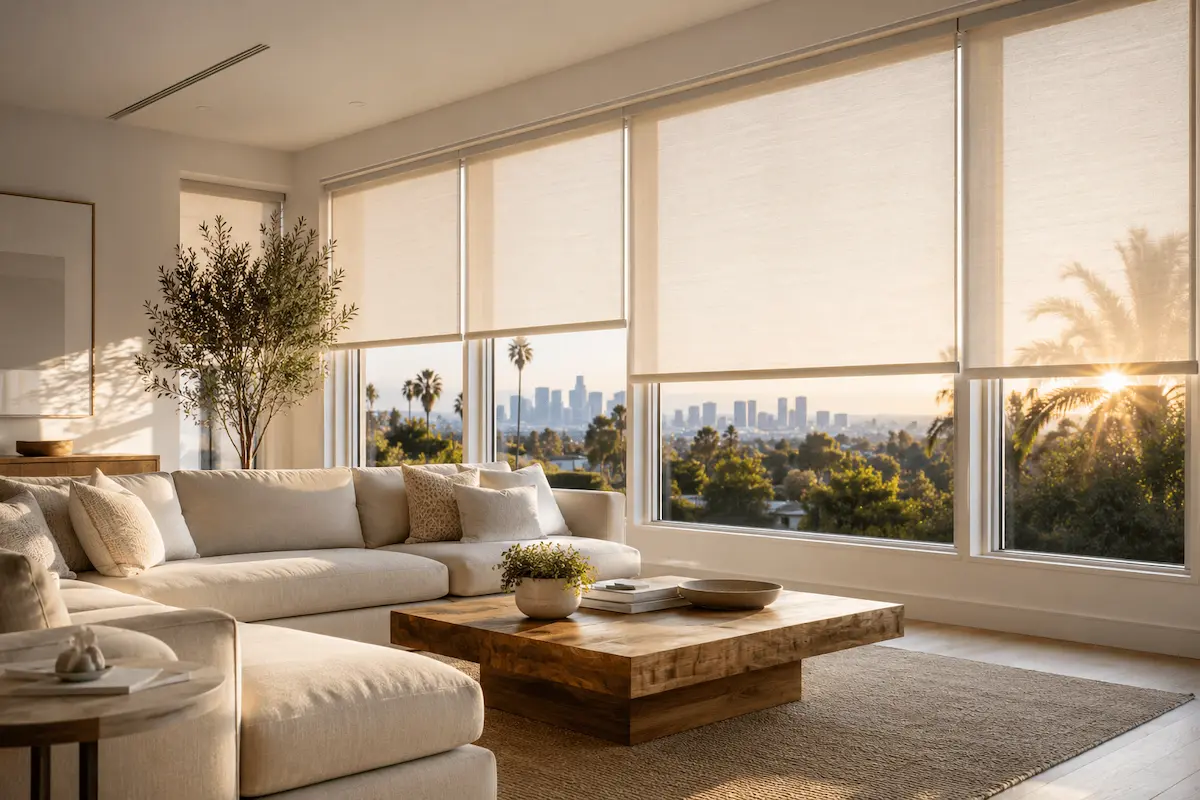
For many modern Los Angeles homes, roller shades are one of the most practical options for managing strong sunlight.
Their simple construction allows them to cover a large portion of the glass without adding visual bulk to the room. When raised, they have a clean, compact appearance. When lowered, the fabric can help manage daylight, glare, and privacy.
The important part is choosing the right fabric.
Different roller shade fabrics provide very different levels of light control. A more open or light-filtering fabric can soften bright sunlight while keeping the room feeling open. A denser fabric provides greater glare and light reduction.
For living rooms, kitchens, and common areas where you still want daylight, a light-filtering or solar-oriented fabric may provide a good balance.
For bedrooms or media rooms, stronger room-darkening options may make more sense.
This flexibility makes roller shades particularly useful in contemporary homes throughout areas such as Sherman Oaks, Studio City, Encino, Van Nuys, and Woodland Hills, where large windows and sliding doors are common.
2. Blackout Roller Shades for Maximum Light Control
Sometimes reducing glare isn’t enough.
Bedrooms, nurseries, home theaters, and rooms receiving intense afternoon sun may benefit from blackout roller shades.
Blackout fabrics are designed to stop most light from passing directly through the material. That makes them useful when you want significantly stronger control over sunlight entering the room.
They can be especially effective for:
- Bedrooms exposed to morning or afternoon sun
- Nurseries
- Media and television rooms
- Guest bedrooms
- Home offices with screen glare
- Windows receiving intense direct sunlight
However, there’s an important detail homeowners sometimes overlook:
Blackout fabric does not automatically mean a completely dark room.
Light can still enter around the edges of the shade depending on the window, mount style, and installation.
That’s one reason professional measurement matters. Choosing the right inside or outside mount and properly sizing the treatment can significantly improve the finished result.
For particularly demanding rooms, layering blackout shades with drapery can provide even greater light control.
3. Light-Filtering Shades When You Still Want Natural Light
Not every sunny room needs to become dark.
In many Los Angeles homes, the goal is actually the opposite: keep the beautiful daylight while making it softer and easier to live with.
That’s where light-filtering shades can work particularly well.
Instead of blocking daylight completely, these fabrics diffuse it. Harsh direct sunlight becomes softer illumination, which can reduce glare while preserving the bright atmosphere that homeowners often want in Southern California interiors.
Light-filtering treatments are especially useful in:
- Living rooms
- Dining rooms
- Kitchens
- Home offices
- Entry areas
- Rooms with attractive outdoor views
The right fabric depends on how much privacy and light control you need.
A room overlooking a private backyard may tolerate a more open material, while a street-facing window in Beverly Hills, Brentwood, or Santa Monica may require greater privacy.
This is why looking at fabric samples inside the actual room is far more useful than selecting a material from a photo online.
Sunlight changes how fabrics look.
4. Roman Shades for Heat Control With a Softer Look
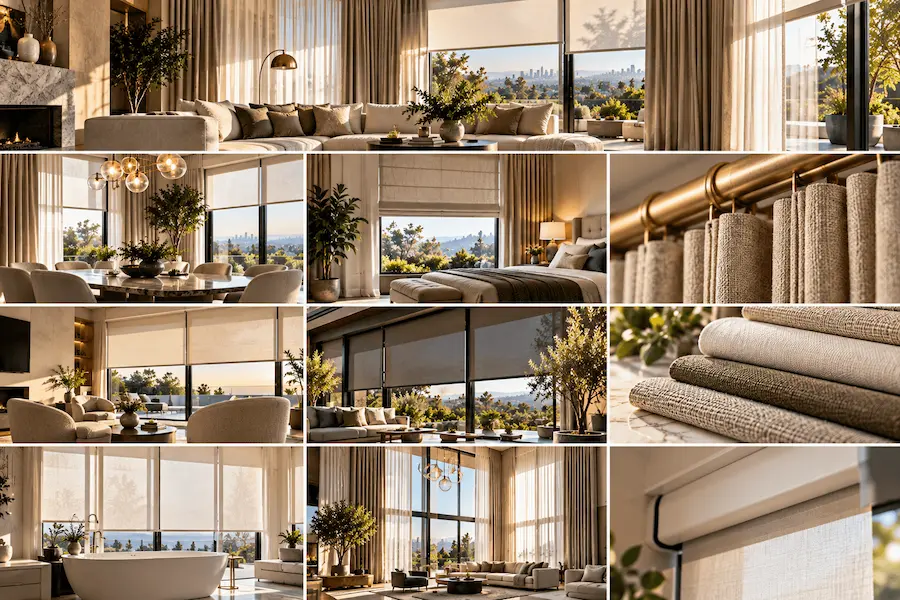
If you want the functionality of a shade but prefer a warmer, more tailored interior, Roman shades are another option worth considering.
Roman shades use fabric that folds neatly as the treatment rises. Compared with the minimal appearance of a roller shade, they introduce more texture and softness into the room.
They work particularly well in:
- Bedrooms
- Dining rooms
- Formal living rooms
- Transitional interiors
- Traditional interiors
- Designer-focused spaces
Fabric and lining selection are particularly important.
A decorative fabric by itself may provide relatively modest light control, while adding an appropriate lining can change how the treatment performs.
That allows the shade to be designed around both the appearance of the room and the amount of sunlight reaching the window.
For homeowners who don’t want a highly modern roller-shade look, Roman shades can provide a useful middle ground between a shade and full drapery.
5. Custom Drapery Adds Another Layer of Protection
Shades aren’t the only solution for sunny windows.
Custom curtains and drapery can provide excellent light management while introducing fabric, texture, color, and architectural presence to the room.
Drapery becomes particularly useful when dealing with:
- Wide windows
- Sliding glass doors
- Floor-to-ceiling glass
- Bedrooms
- Formal living spaces
- Windows where additional light control is needed
One of the biggest advantages of drapery is layering.
For example, a room might use a roller shade directly over the window for everyday sunlight control and full-length drapery in front of it for additional privacy, room darkening, and design.
This gives you more flexibility than relying on a single treatment.
During the day, the shade can manage strong sunlight while keeping the room visually simple. In the evening, the drapery can close for greater privacy and a softer atmosphere.
For larger homes in areas such as Calabasas, Bel Air, Beverly Hills, and Malibu, layered treatments can also complement large architectural windows without making the solution feel purely functional.
6. Motorized Shades Can Manage Sunlight Automatically
There’s another factor that matters more than people realize:
A shade only helps when it’s actually being used.
If a west-facing room starts receiving intense sunlight every afternoon but the shades remain open until someone notices the room getting hot, you’ve already allowed hours of direct sun inside.
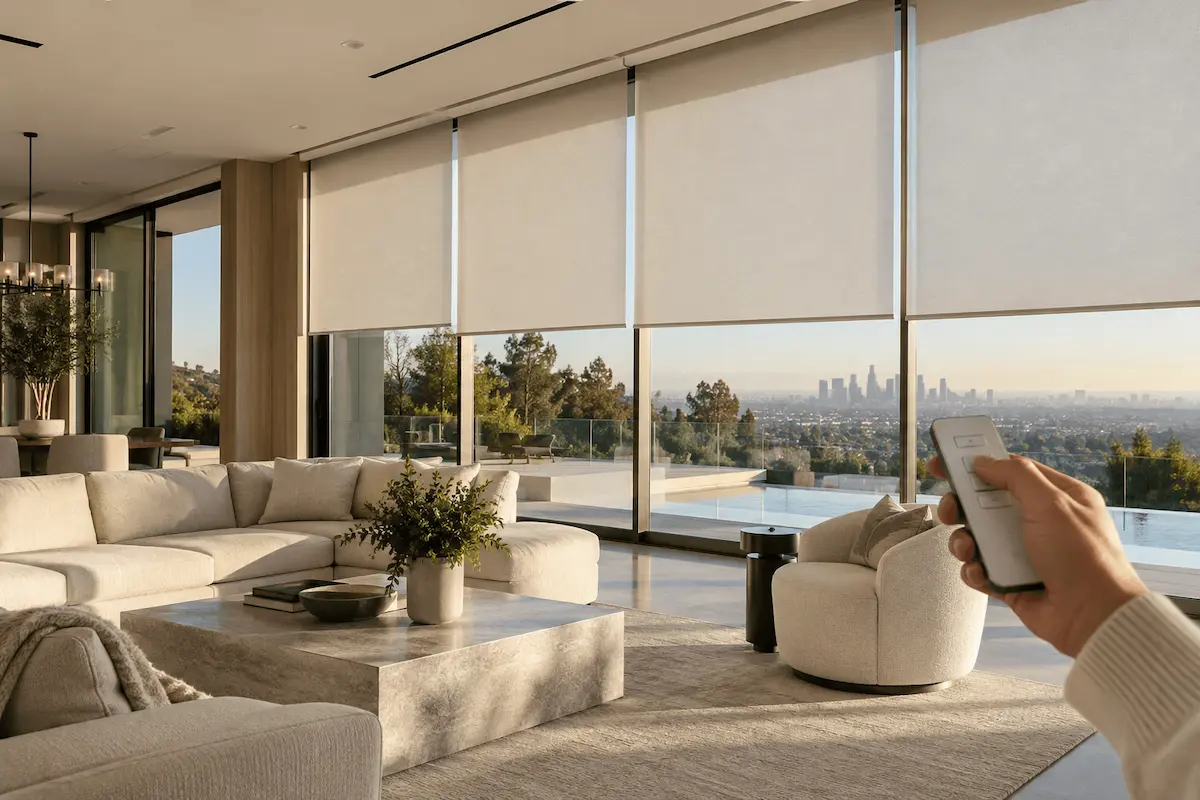
That’s where motorized window treatments become particularly useful.
Depending on the system, motorized shades can be operated using a remote, app, or programmed schedule.
For example, shades on the western side of a home could lower during the strongest afternoon sunlight and reopen later when direct exposure has passed.
This can be particularly convenient for:
- Tall windows
- Large groups of windows
- Hard-to-reach windows
- Second-story windows
- Sliding-door walls
- Homes with many shades
- Rooms that receive predictable direct sunlight
Motorization isn’t only about luxury or convenience. In a sunny climate, automation can help homeowners use their window treatments more consistently.
It’s also possible to automate drapery using motorized curtain tracks, making the same concept practical for large fabric panels and wide openings.
What About Energy-Efficient Window Treatments?
Window coverings are one part of a larger energy-performance system.
The glass itself, window frame, orientation, exterior shading, insulation, and HVAC system all influence indoor comfort.
Still, properly selected window coverings can play a meaningful role.
Research from the U.S. Department of Energy on energy-efficient window attachments shows that certain window attachments can reduce unwanted solar heat gain and improve the energy performance of windows.
That doesn’t mean every shade automatically produces the same result.
Material, construction, fit, color, installation, and how the treatment is actually used all matter.
That’s why we prefer to think about the entire window rather than simply labeling one product as the “best heat-blocking shade.”
Which Window Treatment Is Best for Your Room?
There’s no single answer for every Los Angeles home.
The best solution depends on what you’re trying to accomplish.
Living Room
If you want to preserve daylight while reducing glare, consider roller shades with an appropriate light-filtering fabric.
If the windows are very large, motorization can make everyday operation easier.
Bedroom
Blackout roller shades, lined Roman shades, or layered shades and drapery can provide stronger light control.
Home Office
Glare is often the main problem.
A fabric that reduces direct sunlight without making the entire office dark can make computer screens easier to use while maintaining comfortable daylight.
Media Room
Blackout treatments are usually the stronger choice when screen reflections and outside light need to be minimized.
Sliding Glass Doors
Wide roller shades may work in some situations, while drapery or motorized curtain tracks can be better suited to very wide openings.
The architecture of the door and how frequently it is used should influence the decision.
Don’t Forget the Direction of Your Windows
Two identical rooms can require completely different window treatments simply because their windows face different directions.
A north-facing room may receive relatively soft natural light.
A west-facing room can experience intense direct sunlight late in the day.
This becomes especially noticeable during Southern California summers.
Before choosing fabric, we recommend observing the room at different times of day.
Ask yourself:
When does direct sunlight enter?
Where does glare appear?
Does the room become uncomfortable in the afternoon?
Do you want to preserve the view?
How much nighttime privacy do you need?
These answers are much more useful than choosing a window treatment based on appearance alone.
Why Custom Measurement Matters
Even an excellent fabric can perform poorly if the treatment doesn’t fit the window correctly.
Small measurement differences can create unnecessary light gaps, interfere with operation, or make the finished treatment look uneven.
At RomRollShade, we approach each project by considering the actual windows, room, sunlight, privacy requirements, and design goals before recommending a treatment.
Our team handles measurement and professional installation rather than asking homeowners to estimate dimensions themselves.
That is particularly important for:
- Oversized windows
- Uneven openings
- Inside-mounted shades
- Blackout applications
- Motorized systems
- Large groups of matching windows
- Sliding glass doors
The goal isn’t simply to cover the glass.
It’s to create a window treatment that works naturally with the room.
Choosing Window Treatments for Los Angeles Homes
Southern California homes are incredibly varied.
A sun-filled contemporary home in Calabasas doesn’t necessarily need the same solution as a condo in Santa Monica, a traditional home in Encino, or a hillside property near Bel Air.
That’s why the best window treatment usually comes from balancing four things:
Light control. Comfort. Privacy. Design.
Roller shades offer a clean and versatile solution.
Blackout shades provide stronger light control.
Roman shades introduce softness and texture.
Drapery adds another layer of flexibility and design.
Motorization makes managing changing sunlight easier throughout the day.
And in many homes, the best solution is actually a combination of two treatments rather than one.
Get Help Choosing the Right Window Treatment
If you’re dealing with hot rooms, intense afternoon sunlight, glare, or large sun-facing windows, the best place to choose a treatment is inside the actual space.
RomRollShade is based in Van Nuys and serves homeowners throughout the San Fernando Valley and West Los Angeles, including Sherman Oaks, Studio City, Encino, Woodland Hills, Calabasas, Bel Air, Beverly Hills, Brentwood, Santa Monica, Pacific Palisades, Malibu, and surrounding communities.
We can look at the windows, discuss how sunlight moves through the room, compare fabrics and control options, and recommend a solution based on how you actually use the space.
Explore our custom window treatments or request a consultation to start planning your project.
Frequently Asked Questions
What are the best window treatments for Los Angeles heat?
There isn’t one treatment that’s best for every home. Roller shades, blackout shades, lined Roman shades, and drapery can all help manage strong sunlight. The right option depends on window orientation, room use, desired daylight, privacy, and design.
Do blackout shades help with heat?
Dense blackout fabrics block direct sunlight through the material and can make bright, sun-exposed rooms more comfortable. However, overall thermal performance also depends on the window, installation, fit, and surrounding building conditions.
Should I choose blackout or light-filtering shades?
Choose blackout when darkness and strong light control are priorities, particularly in bedrooms and media rooms. Choose light-filtering treatments when you want to soften direct sunlight while preserving more natural daylight.
Are motorized shades useful for sunny windows?
Yes. Motorization can be especially useful for windows that receive strong sunlight at predictable times. Compatible systems can allow shades to operate by remote, app, or schedule so you don’t have to manually adjust every window throughout the day.
Can I combine roller shades with curtains?
Absolutely. Layering a roller shade with custom drapery gives you multiple levels of light control and privacy while also adding texture and softness to the room.
Does professional installation make a difference?
Yes, particularly with blackout, oversized, and motorized treatments. Accurate measurement and installation affect light gaps, alignment, operation, appearance, and how well the treatment fits the window.